
June 24, 2026
How Strategic Choice-Making© Works
From Charger to Civic Energy Node.
Related sites
Download dissertation
Authors
Deaa Bataineh
A charging station looks simple from the outside.
A car parks. A cable connects. Energy moves from the grid into a battery. A driver waits, pays, and leaves. From this angle, the charging station appears to be just another technical object in the landscape of clean mobility.
But this is not really what it is.
An EV charging station is becoming one of the small but critical sites where the energy transition is being negotiated. It touches the electricity grid, the future of mobility, real estate, payment systems, data platforms, public incentives, private investment, urban planning, and everyday routines. It raises questions of access: who gets to charge, where, at what speed, at what price, and under what conditions? It raises questions of sustainability: when is the energy clean, how is demand managed, and what happens to the grid when millions of vehicles plug in? It also raises questions of value: who owns the station, who operates it, who controls the data, and who benefits from the infrastructure being built?
It is an everyday infrastructure because it enters the rhythm of ordinary life. It is infrastructure because, once enough people depend on it, it becomes part of the background condition that allows life, work, and movement to happen. Like roads, water pipes, payment rails, and mobile networks, it becomes most important when people stop noticing it—until it fails, excludes them, or charges them differently.
The design challenge, then, is not simply how to make a better charger. It is about how to make better choices around the charger.
This is where Strategic Choice-Making© becomes useful as a framework.
Strategic Choice-Making© is a way for institutions to move from large forces—such as clean energy, digitization, equity, financialization, and economic resilience—toward concrete choices that can be designed, tested, governed, and scaled. It helps us ask how a broad transformation becomes operational. Not in slogans. Not only in strategy documents. But in features.
A feature can be a pricing rule, a charging speed, a payment option, a reservation system, a data-sharing protocol, a siting decision, a maintenance dashboard, a grid-balancing mechanism, or a bidirectional charging capability. These may seem small. But in complex systems, small features can redirect major flows.
A charging station, for example, does not only move electricity. It can move money, data, trust, access, carbon, and institutional responsibility. The question is whether those flows are being shaped deliberately.
Before the framework: reading the system
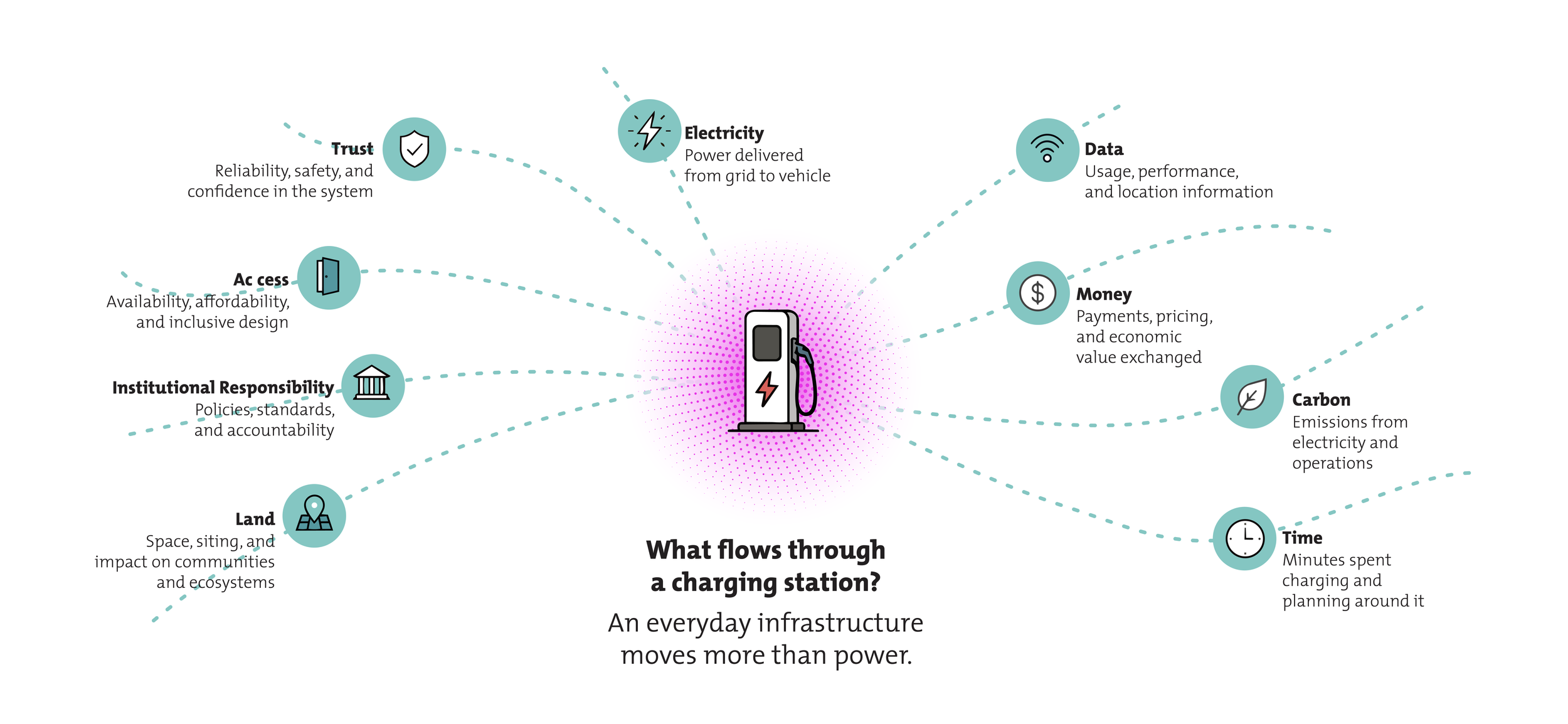
Reframing resource flows through strategic choice-making©
Strategic Choice-Making© does not begin with brainstorming. It begins with reading the system.
Before we ask what to design, we need to ask what is already moving. What resources are being generated, stored, moved, monitored, managed, or controlled? Who has access to them? Who is excluded? What is the system already optimized for? What is it failing to see?
In the case of EV charging, the obvious resource is electricity. But electricity is only the beginning. There is also land. There is parking. There is time. There is capital investment. There is vehicle data. There is grid capacity. There is a public subsidy. There is user attention. There is neighborhood trust. There is the question of whether charging infrastructure appears first in affluent areas and last in underserved ones.
This first act of reading the system is important because complex innovation rarely begins from a blank page. It begins inside existing conditions. The charger arrives in an already uneven world: uneven grids, uneven incomes, uneven parking access, uneven digital literacy, uneven public investment, and uneven institutional capacity.
So the first question is not “What is the solution?” The first question is: What is the space of choices?
A macro assessment helps define this space. It looks at the problem space and the opportunity space together. The problem space might include weak grid capacity, lack of public charging, high installation costs, fragmented operators, unreliable maintenance, or inequitable access. The opportunity space might include clean energy adoption, local economic development, public-private partnerships, better demand management, new service models, or a more resilient grid.
This is where the framework begins to matter. It helps institutions avoid jumping too quickly from problem to product. Instead, it asks them to understand the flows first.
1. Prompting: setting the strategic agenda
The first stage is Prompting.
Prompting is where the institution decides what kind of future it is actually trying to make possible.
This sounds simple, but it is often where the work either opens up or narrows down too early. If the prompt is “design a better charging experience,” the team may focus on the interface, the payment flow, or the waiting time. Those are useful concerns, but they are not enough.
A more strategic prompt might ask:
How might EV charging accelerate the clean energy transition while expanding equitable access to mobility?
That is a different kind of question. It does not treat the charger as an isolated product. It treats it as part of a system. It asks the team to consider energy, mobility, equity, data, finance, and public value at once.
Another prompt might ask:
How might a charging station become a grid asset rather than only a point of consumption?
This opens another space of choices. It may lead to features such as dynamic pricing, managed charging, battery storage, renewable energy integration, or bidirectional charging. Suddenly, the station is no longer only serving the driver. It is also serving the grid.
This is why Prompting matters. A prompt is not just a question. It is an institutional orientation. It tells the design process what to take seriously.
In Strategic Choice-Making©, Prompting clarifies the agenda. What macro force is being addressed? What institutional purpose is guiding the work? What resources are in play? What kind of value should be created? What should not be compromised?
The prompt shapes what becomes visible.
2. Prototyping: making choices visible.
The second stage is Prototyping.
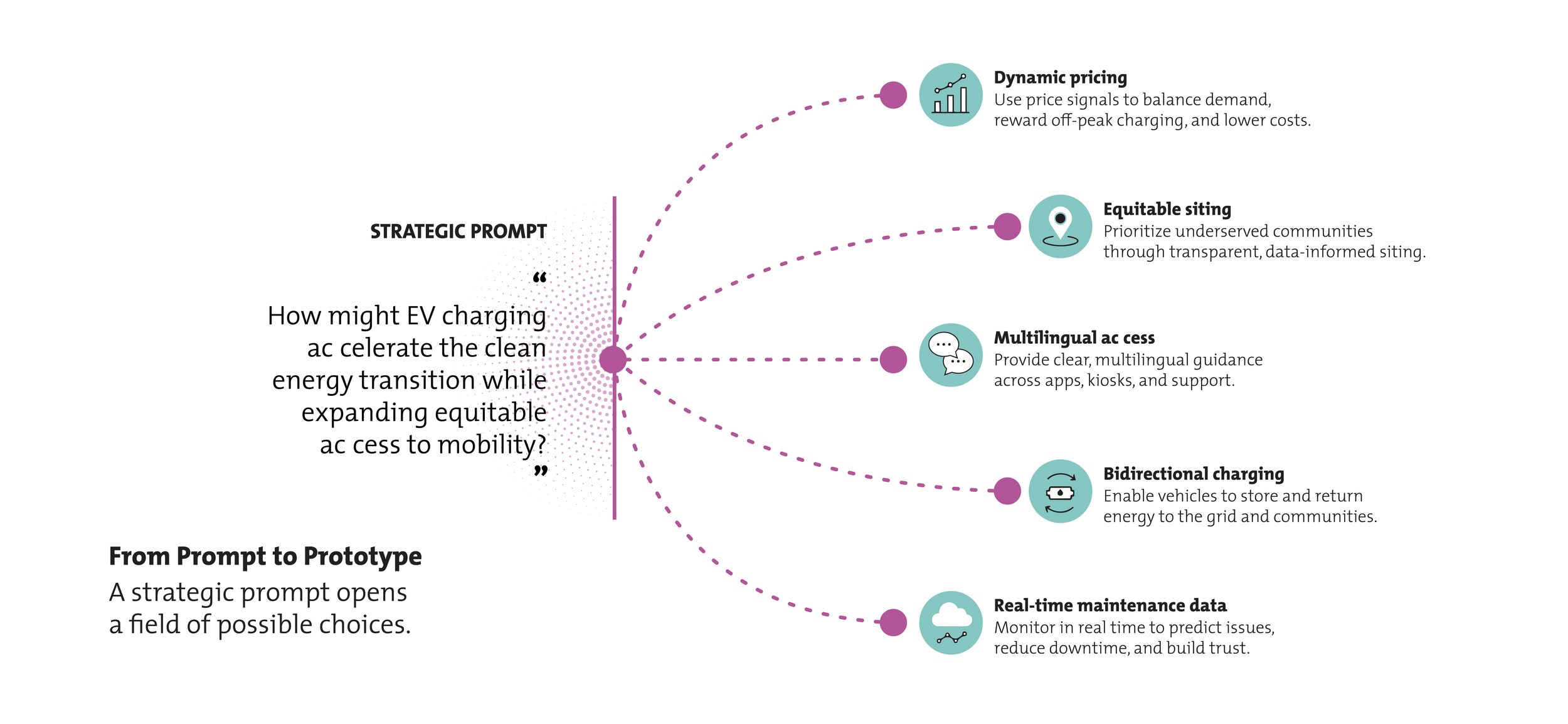
from a prompt to a prototype; making possible feature-level choices
In many design processes, a prototype is understood as an early version of a product or service. In this framework, a prototype is more than that. It is a way of making a choice visible.
If a city prototypes a charging station with multilingual instructions, it is making a choice about access. If a company prototypes a subscription model, it is making a choice about revenue and lock-in. If a utility prototype manages charging, it is making a choice about grid coordination. If a parking operator prototypes chargers only in premium locations, it is making a choice about who the transition is for.
Every prototype carries an argument.
The point of prototyping, then, is not only to ask whether something works. It is to ask what it changes.
Does this feature reduce friction or simply move the burden somewhere else? Does it make charging more accessible or more exclusive? Does it reduce emissions or only shift demand to a different part of the system? Does it create public value or mostly private capture? Does it help the institution learn something it could not see before?
This is the difference between prototyping an object and prototyping a strategic choice.
A charger can be tested for usability. But a charging feature must also be tested for consequences. What happens if pricing changes by time of day? What happens if users can reserve charging slots? What happens if chargers are placed near transit hubs rather than only shopping centers? What happens if the station can return electricity to the grid? What happens if the data is shared with the city, the utility, the operator, or the user?
Each prototype opens a small window into a larger system.
3. Archetyping: seeing the pattern behind the features
The third stage is Archetyping.This is where individual features begin to form a larger pattern.
A single charging feature may improve convenience. But a bundle of features can create a new archetype for the energy transition.
For example, imagine a charging station with dynamic pricing, renewable-energy matching, battery storage, grid-responsive charging, public access requirements, transparent maintenance data, and neighborhood-level siting criteria. Individually, these are features. Together, they begin to suggest something larger: a civic energy node.
This is no longer just a charger. It is a local interface between mobility, energy, data, and public value.
Another bundle might include premium reservations, loyalty programs, retail partnerships, proprietary payment systems, and exclusive fast-charging access. This suggests a different archetype: the charging station as a platformed mobility service.
Both are possible. Both may be investable. Both may be technically feasible. But they do not produce the same future.
This is why archetyping is important. It helps institutions see that they are not only choosing features. They are choosing patterns of value creation.
In complex spaces of innovation, transformation does not usually happen through one isolated feature. It happens when features reinforce one another. They cluster into an operating logic. They create a new relationship between users, institutions, infrastructures, and platforms.
The archetype gives that relationship a name.
It allows teams to ask: What is this becoming? Is this a public infrastructure? A private platform? A hybrid system? A neighborhood service? A grid asset? A data business? A mobility gateway? A climate intervention?
Without archetyping, institutions may keep improving parts without understanding the whole they are building.
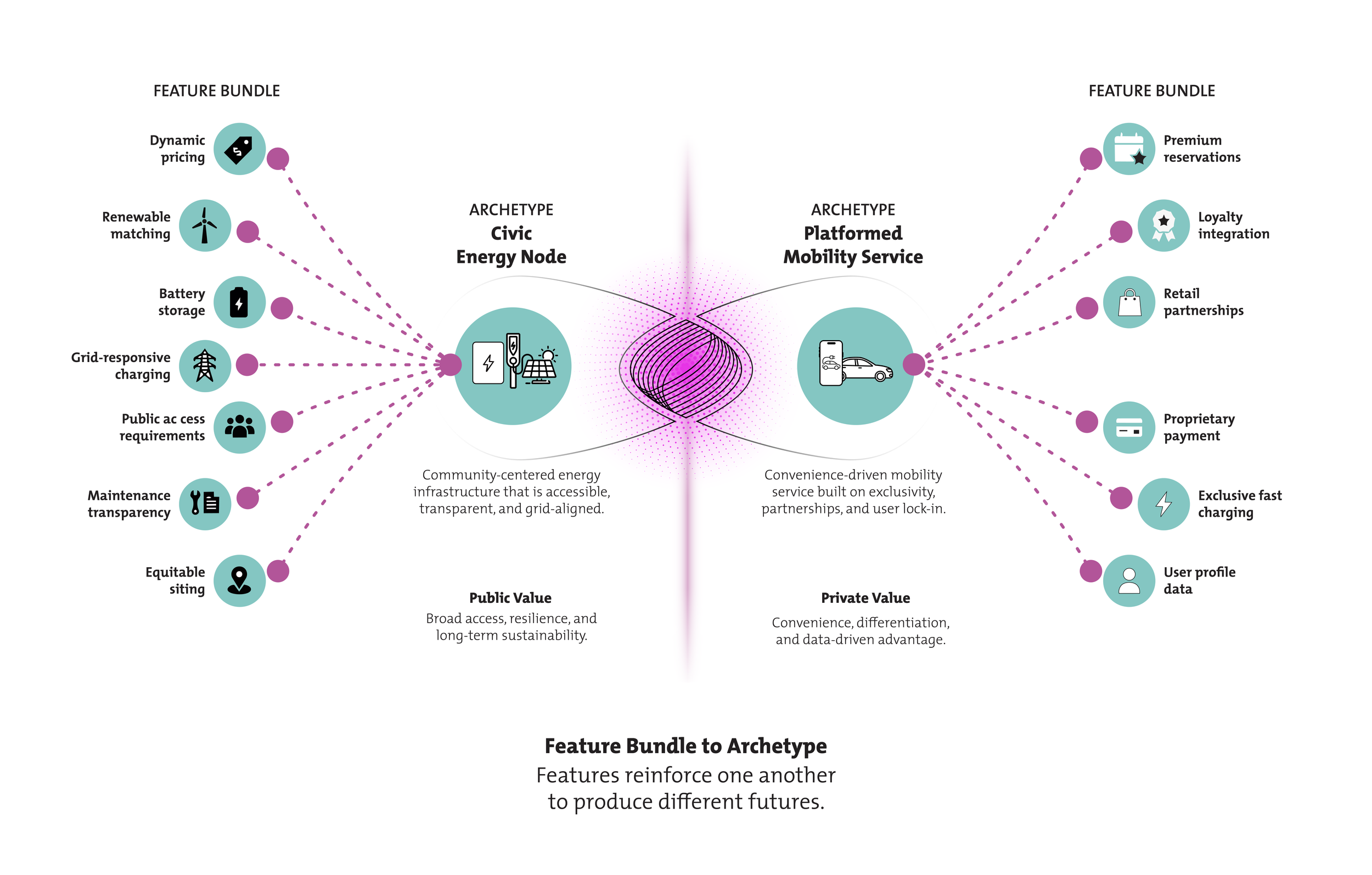
Feature bundle to archetype: a two-column or layered diagram. On the left: individual features. On the right: the emerging archetype.
4. Infrastructuring / Platforming: embedding choices into systems
The final stage is Infrastructuring/Platforming.This is where the framework moves beyond the launch of an offering and asks whether the choice can become part of a durable system.
Infrastructuring asks: What makes this reliable, accessible, maintainable, and accountable over time?
For EV charging, that could mean standards, grid upgrades, maintenance systems, public funding, universal access requirements, zoning, interoperability, safety protocols, and long-term governance.
Platforming asks: What makes this capable of coordination, monitoring, learning, and adaptation?
That could mean data dashboards, demand forecasting, payment systems, user profiles, operator networks, pricing algorithms, and interfaces between the vehicle, the charger, the grid, and the institution.
In today’s infrastructure-platform mashups, these two logics often come together. The charging station must be infrastructural enough to be trusted and platformed enough to coordinate complex flows in real time.
This is a delicate balance.
If it becomes only infrastructure, it may be reliable but slow to adapt. If it becomes only platform, it may be adaptive but too extractive, fragmented, or exclusionary. The work is to design the relationship between the two.
This is why the final stage is not implementation in the narrow sense. It is the embedding of choices into institutions, markets, policies, and everyday practices.
A charging station becomes meaningful when it is not just installed, but governed. When it is maintained. When it is accessible. When it is connected to the grid responsibly. When it serves more than one kind of user. When it can adapt as energy systems change.
The goal is not simply to place more chargers in the world. The goal is to design charging as part of the clean energy transition.
Feature bundle to archetype: a two-column or layered diagram. On the left: individual features. On the right: the emerging archetype.
4. Infrastructuring / Platforming: embedding choices into systems
The final stage is Infrastructuring/Platforming.This is where the framework moves beyond the launch of an offering and asks whether the choice can become part of a durable system.
Infrastructuring asks: What makes this reliable, accessible, maintainable, and accountable over time?
For EV charging, that could mean standards, grid upgrades, maintenance systems, public funding, universal access requirements, zoning, interoperability, safety protocols, and long-term governance.
Platforming asks: What makes this capable of coordination, monitoring, learning, and adaptation?
That could mean data dashboards, demand forecasting, payment systems, user profiles, operator networks, pricing algorithms, and interfaces between the vehicle, the charger, the grid, and the institution.
In today’s infrastructure-platform mashups, these two logics often come together. The charging station must be infrastructural enough to be trusted and platformed enough to coordinate complex flows in real time.
This is a delicate balance.
If it becomes only infrastructure, it may be reliable but slow to adapt. If it becomes only platform, it may be adaptive but too extractive, fragmented, or exclusionary. The work is to design the relationship between the two.
This is why the final stage is not implementation in the narrow sense. It is the embedding of choices into institutions, markets, policies, and everyday practices.
A charging station becomes meaningful when it is not just installed, but governed. When it is maintained. When it is accessible. When it is connected to the grid responsibly. When it serves more than one kind of user. When it can adapt as energy systems change.
The goal is not simply to place more chargers in the world. The goal is to design charging as part of the clean energy transition.
ABOUT THE AUTHORS:

Deaa Bataineh is a designer, researcher, and consultant specializing in innovation at the intersection of systems, design, and strategy. He holds a PhD from the Institute of Design (ID) at Illinois Institute of Technology, where he developed the Strategic Choice-Making© model. His work addresses complex infrastructures—such as EV charging, emergency response, and digital payments—as platforms for equitable and sustainable transformation. He serves on the Aux Board of the Design Museum of Chicago, co-founded the design department at Jordan University of Science and Technology in Jordan, and hosts the podcast espresso?. For more visit Deaa’s website here.